
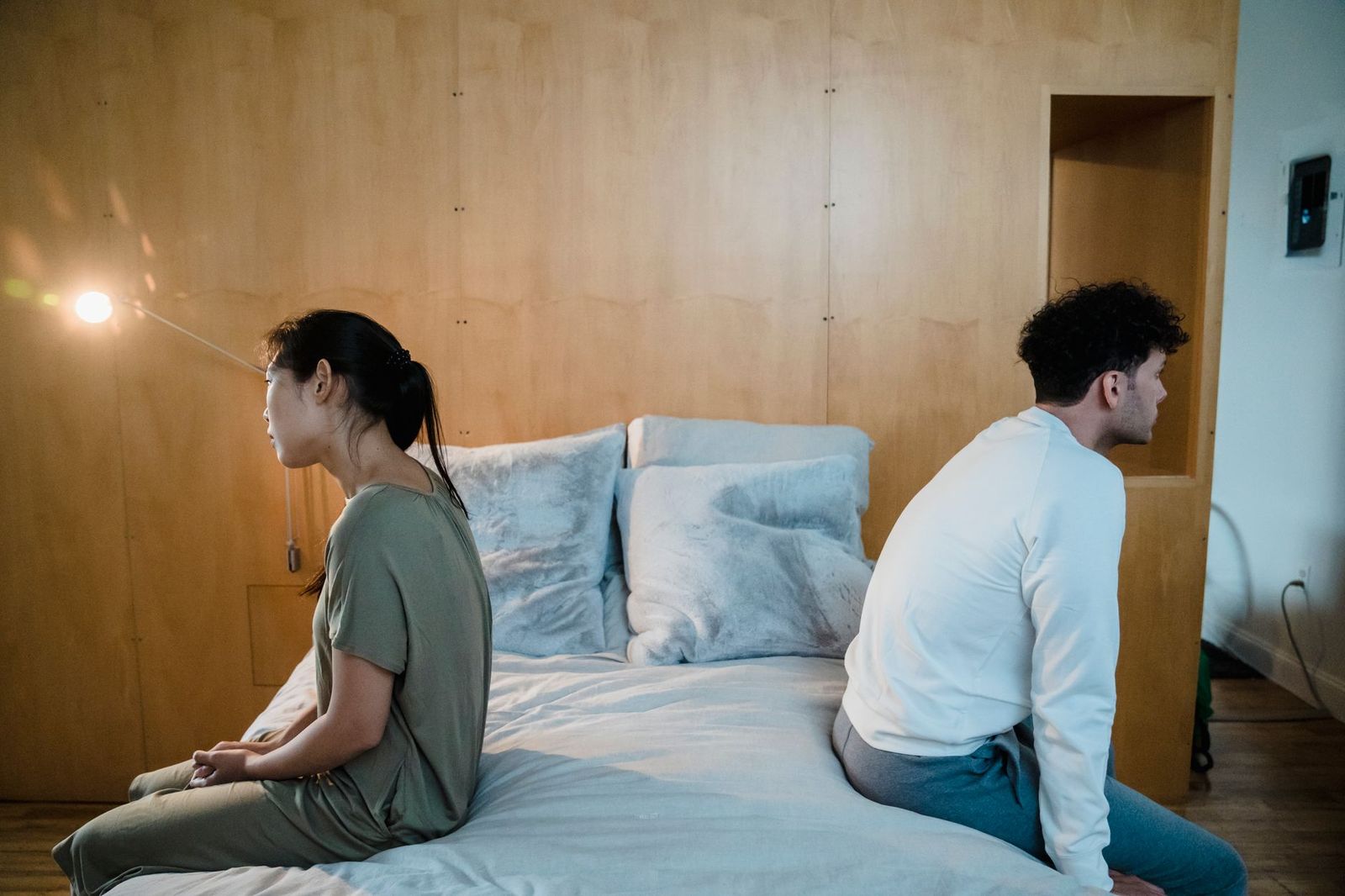
He’s not avoiding you. For most men, eyes closed or gaze averted during sex is the brain turning down visual input so the body can feel more, not a verdict on your body. It’s the same reason you close your eyes when you kiss someone hard or when you’re alone with your hand. But not every version is normal, and there’s a way to ask for his eyes that doesn’t land like an accusation.
You know the scene: 11:20 p.m., lights off, he finishes with his eyes shut, rolls onto his side, and you’re still awake, phone glowing, searching for this. Let’s sort the actual reasons first, then what to do.
The myth: looking away means he’s not present
The standard advice on this question is wrong. It goes: eye contact is intimacy, so if he won’t look at you, he’s not really there, and you should find someone who can’t keep his eyes off you. That framing turns his gaze into a report card on your desirability. It also ignores something basic: for many men, eye contact during sex isn’t intimacy, it’s noise.
Watch the men you’ve been with. The ones who stare the whole time are often performing. They’re watching themselves watch you. The ones who close their eyes aren’t withdrawing. They’re concentrating. There’s a difference between a man who avoids your eyes because he’s checked out and a man who shuts his eyes because he’s working to feel everything at once. The second one is usually the more present one, not the less.

Photo: Vinicius Quaresma / Pexels
What his eyes are actually doing
Here’s the body fact. Touch and sight compete for the same attention budget. Your visual cortex is one of the most demanding parts of the brain, and when you’re close to orgasm, brain imaging shows that visual processing actually quiets down. The brain literally reduces visual input so it can turn up the physical sensation. That’s why people’s eyes flutter shut at the moment of coming. It isn’t boredom. It’s the volume knob.
Men have an extra layer. They’re strongly visually stimulated during early arousal, so they look a lot at the start: at your body, at the scene, at what’s happening. But as arousal climbs, the visual stops helping. Staring into your eyes raises heart rate and activates the same pathways as physical touch. For some men that’s overstimulating, so they look away to keep from coming too soon or to stay inside the sensation. A man averting his gaze at 1 a.m. is often doing the opposite of rejecting you: he’s in the middle of it.
We don’t have studies that specifically measure eye contact during partnered sex. This is inference from arousal research and from what men say when you finally get them to talk honestly. But the pattern holds: early arousal is visual, late arousal is physical, and the eyes close when the body takes over.
Where his gaze goes, and what it means
The pattern matters more than the act. Four common ones:
- Eyes closed the whole time. He’s focused on sensation from the start. This is the most common and the least personal. It’s not you, it’s his wiring.
- Looks at your body but never your face. He’s visually engaged, but your eyes are too intense. This is usually shyness or performance anxiety, not coldness.
- Looks away only near the end. The most normal version of all. The brain is shutting down visual processing to cross the finish line.
- Looks at your face but drops his gaze the second you look back. That’s self-consciousness. He doesn’t want to be caught staring, and he’s not sure what your eyes are asking of him.
Here’s the solo test, and you can do it tonight. When you masturbate, do your eyes close? Almost every woman’s do. You close them to feel more. That’s the same brain he has. If you’ve ever opened your eyes mid-solo and lost the sensation, you already know why he looks away.
The fail bank: five moves that make it worse
The wrong moves are all versions of turning his gaze into a test. Don’t do these:
- Asking “why don’t you look at me?” mid-thrust. You will never get an honest, useful answer while he’s inside you. He’ll hear an accusation, and he’ll shut down.
- Grabbing his face and turning it toward yours. That makes him feel managed, and it turns a moment into a command.
- Changing how you look to earn the gaze. New lingerie, losing weight, different angles. The problem is his attention budget, not your presentation.
- Squinting to catch him in the act of not looking. Surveillance kills the mood faster than averted eyes ever could.
- Bringing it up after sex, half-asleep, as a complaint. He can’t respond without it becoming a fight, so it becomes a fight.
- Assembling it into a case. “He never looks at me, he doesn’t want me, our whole relationship is broken.” That’s projection onto an ambiguous clue.
You already brought it up. It got weird.
If you asked him mid-sex and he went quiet, you’re in a specific mess: the words are out, and now the night has a ceiling on it. Don’t double down. Don’t explain your feelings at 1 a.m. What works is a short retreat:
“I wasn’t trying to accuse you. I know you’re focusing. I just miss your face when you come. Forget it for tonight.”
Say it in the morning if you said it at night. Then don’t reintroduce it for a few days. He needs to see that asking for his eyes isn’t a trap.
If you haven’t said anything yet, don’t make this an investigation. No replaying the last six sessions to find the first time he looked away. Pick one specific moment and one specific request, which is the next section.
What to say tonight
The difference between a request he can hear and a request he can’t is whether it’s about him failing or about what you want.
The ego version: “You never look at me.” He hears: “You’re bad in bed and I’m not attracted to you.”
The care version is concrete, positive, and small:
“I love watching your face when you’re close. Next time, before you come, look at me for ten seconds. I want to see your eyes.”
That’s a gift, not an audit. It tells him exactly what to do, for exactly how long, and why. Most men don’t know you want the gaze. They’ve either assumed porn-style watching is the norm, or they’ve been with women who closed their eyes and they matched the signal. You have to request the thing, clearly, once.
Also worth knowing: some positions make it easier. On his back, with you on top or beside him, eye contact is nearly effortless. From behind, expect less. That’s not a comment on your relationship; it’s logistics.
When it isn’t his brain, it’s him
The doubt can be accurate. Not every averted gaze is innocent arousal wiring. Some men are looking away because they’re elsewhere, and you can usually tell the difference by what else is true.
If he avoids your eyes in bed but looks at you fine everywhere else, in conversation, in the kitchen, in the car, that’s almost certainly the brain stuff above. But if he never meets your eyes anywhere, if he turns away from your touch, if his hand keeps finding his phone, if the sex has the energy of a task being completed, then the gaze is one symptom of a larger disconnection. Don’t explain that away with neuroscience.
There’s also a version where you’re using his gaze to prove you’re desirable, and no amount of eye contact will fix that. If good sex feels ruined because he didn’t look, and you’re collecting evidence of his disinterest across every area of life, that’s worth taking to a therapist. Eye contact is a preference. It was never the proof.

Photo: https://kaboompics.com/ / Pexels
The ten-second test
Next time, change one variable. Not the position, not the lighting, not your whole approach to sex. One variable.
When he’s close, say the line. “Ten seconds. Look at me.” If he does it, even for two seconds, that’s a win. Don’t push for the whole session to be eye-locked. Don’t debrief afterward. Let the small moment land. Then ask again next time. Men learn what’s rewarded, and a man who sees that looking at you gets him your face, your voice, your reaction, will start looking on his own within a few weeks.
If you ask twice, clearly, warmly, and he still never looks once, that’s your escalation point. Have the conversation outside the bedroom, fully clothed, and make it about connection, not about the act: “I want to feel like you’re with me. When your eyes are closed the whole time, I can’t tell.” No ten-second framing, no test. A real conversation.
What you can do tonight
Nothing with him. Tonight you do the solo test, and you watch yourself. Close your eyes next time your hand takes over and notice how much more you feel. That’s the exact brain you’ve been asking about. If you want him to look at you next time, the line is ready, and you’ll say it once, at the right moment. And if it turns out he’s not looking because he’s not there, you already know what else to look for. Either way, you stop searching for the answer at 1 a.m. You already have it.