

The one-word reply isn’t the problem
You’re not dry because you’re bad at texting. You’re dry because you’re treating the phone like a receipt you have to sign. He says something, you react, you hit send, done. That’s answering, not talking. In person, you’d never just say “haha” to a friend’s story. You’d lean in, ask a follow-up, make a face, throw a joke back. The phone is flattening you because you’re letting it run on autopilot.
The fix is not more emojis. Emojis on a dead message are just a smiley on a tombstone. The fix is deciding that text is a conversation, not a transaction. You don’t have to be clever. You have to be present.
Here’s the part nobody says out loud: everyone thinks they’re dry. The woman with the two-word replies thinks it. The guy who sends “lol” and nothing else thinks it. The difference is not natural talent. It’s what you do with the material you’re given.
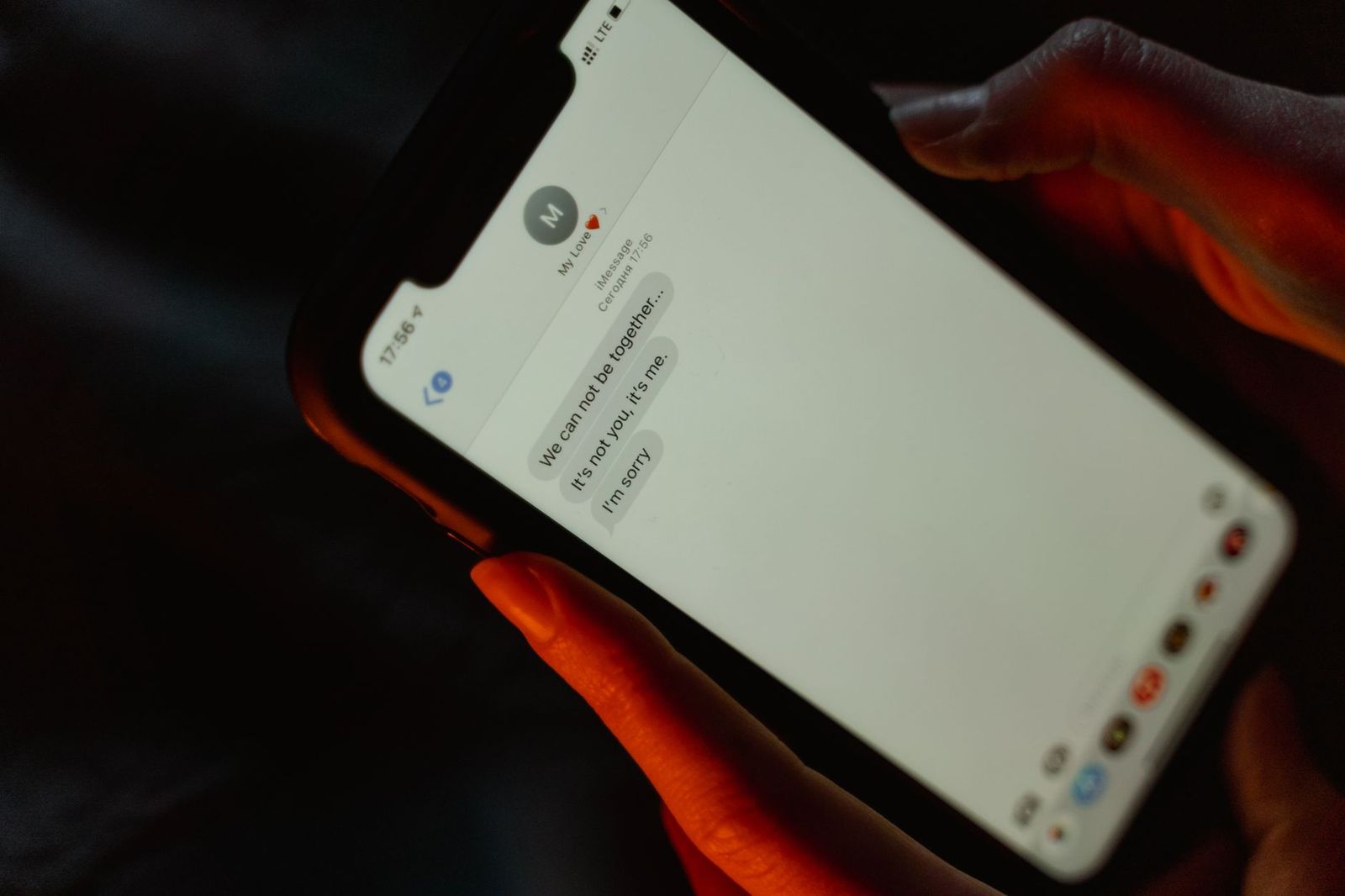
Photo: MART PRODUCTION / Pexels
If you’ve already made it worse
You’ve got a thread that’s five messages of “haha” and “yeah” and you don’t know how to exit without announcing that you’re doing something different. Do not send “sorry I’m so bad at texting.” That’s not an apology, that’s an excuse that gives the conversation a reason to stay dead.
The clean start: just send something that doesn’t reference the dry streak at all. You don’t have to acknowledge the awkwardness. You don’t have to explain that you’re actually warm in person. You just have to send one message that has a pulse. If he’s been matching your energy, he’ll probably match your new energy too. If he’s been giving you one-word replies since the beginning, that’s data, not a challenge.
Two situations that change the advice
You met him at a party and you’re texting a near-stranger. Low stakes. You don’t have material to reference yet, so you’re building from scratch. The goal is not to become pen pals. The goal is to get to a drink or a call quickly, because text is the worst format for getting to know someone.
You’ve already been on a date (or three). Now you have ammunition. Something he said, something you both laughed at, the weird waiter. You can reference it. This changes everything because you’re no longer doing interview questions. You’re continuing a conversation that already exists.
The observable tell: if you’re reading your own messages and they all end with a question mark, you’re in interview mode. If you’re replying to his questions and adding nothing, you’re in resume mode. Both of those are jobs. Neither of those is a conversation.
The advice that makes you drier
Here’s the common advice that makes this worse: “Ask open-ended questions.” So you do. You ask what he’s into, what his weekend looks like, what he thinks about the thing you both mentioned. And it works for about two rounds, and then it dies anyway. Because a question is not a conversation. A question is a job application. You ask, he answers, now it’s your turn to ask again, and you’re both exhausted.
The other classic: “Use more emojis.” This is the beauty filter of texting. It doesn’t make you warmer, it makes you look like you’re trying to look warmer. If the words are dead, the winky face is not going to resurrect them.
And the third one: “Be playful.” That’s like telling someone to be interesting. It’s a command, not a method. Every woman who has ever stared at a blank text box knows that “be playful” is just a way to feel worse about yourself.
The move is not a better question. The move is a statement with a hook. You say what you think, then you hand him a small opening. That’s how people talk in person. Nobody says “so, what are your hobbies?” at a bar. They say “I cannot believe you ate the whole thing” or “that song is terrible and I love it.” Statements. With edges.
Scripts that don’t sound like a performance
These are not perfect. That’s the point. Read them out loud before you send. If you wouldn’t say it to a friend, don’t say it to him.
Situation one: he said something you actually found funny.
Instead of: “haha that’s funny”
I laughed out loud at “the cat has a better sleep schedule than me” and now I’m judging my own life choices.
Situation two: he asked the boring “how’s your day” question.
Instead of: “good you”
my day was 80% meetings and 20% me planning my exit. tell me something good from yours so I can live vicariously.
Situation three: you’re after a date and the thread is fading.
Instead of: “hey how are you”
I’m still thinking about the way that waitress looked at us when you said pickle. are we going back or are we never showing our faces there again?
Situation four: you have nothing to say and you want to start a new thread.
Instead of: “hey, what’s up”
I just saw a dog wearing a tiny raincoat and I need to tell someone. what’s something small that made you smile today?
Notice what these have in common. They’re not perfect. They’re not witty one-liners. They’re the kinds of things you’d actually say out loud. That’s the whole game. Text that reads like speech.
Before you send: the three-message scroll
Here’s the pre-move. Open the thread and scroll up to the last five messages you sent. Count how many of them are questions. If three or more are questions, that’s why the conversation is dying. You’re doing all the lifting, and it feels like an interrogation.
Now look at his last three replies. If they’re all one word, the problem isn’t you. But if his replies have length and yours are short, you’re the one holding the conversation hostage.
One more thing: before you send anything tonight, say it out loud. If it sounds like something you’d actually say, send it. If it sounds like a greeting card, rewrite it. If you can’t say it out loud without cringing, don’t send it. That’s the whole filter.
The three-exchange window
Here’s the stop rule. You get three exchanges, max, on a text thread before you move it somewhere real. That means: you send a message, he replies, you reply, he replies, you add one more thing, and then you say “this is fun, let’s do it over a drink” or “I’m going to call you in five minutes” or you send a voice note and ask him to send one back.
Three exchanges. That’s a limit, not a goal. If you hit three and you’re still doing “haha” and “lol,” that thread is done. Stop adding to it. Let it sit. If he wants to talk, he’ll pick it back up. If he doesn’t, you have your answer, and it’s not a texting problem, it’s a “not that interested” problem.
Why three? Because text is a terrible way to get to know someone. It has no tone, no face, no timing. The only thing text is good for is logistics and flirting that leads to something else. Every text thread that goes longer than three exchanges without a call or a date is just two people refreshing their inboxes and wondering why they feel worse.

Photo: Zen Chung / Pexels
When it keeps dying
You did the work. You sent the callback, you made the statement, you moved it to a call, and the conversation still flatlines. Now you have to look at the ugly option: he might be boring. And you might be dry because there’s nothing to bite onto. You can’t have a good text exchange with someone who gives you nothing. You can be the warmest person on the planet, and a brick wall is still a brick wall.
So the escalation is: you stop being the person who starts every conversation. You let it go quiet for a few days. If he comes back with something that has a pulse, you have a thread. If he comes back with “hey” at 11 p.m., you have a booty call pattern, and that’s a different conversation.
And if you’re the one who always starts, take a real pause. Not a dramatic “I’m not texting him anymore” pause. Just a few days of not being the first to reach out. The people who want to talk to you will talk to you. Everyone else, you’ve just freed up some mental space.
Tonight: leave with one send
Here’s your one move for tonight. Pick the last thing he said that had anything in it, and send one message that references it. Not a question. A statement, with a small hook. Something like “I’ve been thinking about what you said about the bread place and now I need to go there this weekend” or “you ruined that song for me, in a good way.”
Send it. Then put the phone down. Don’t watch the read receipts. Don’t craft a follow-up. The thread now has your warmest foot forward, and what happens next is 50% him. That’s not a cop-out. That’s the actual math.
If he replies with something that has any length to it, you’re back in the game. If he doesn’t, you’ve spent exactly one message testing the water, and the water told you what it was. Either way, you’re not the dry one anymore. You’re the two-word-reply version of yourself, and she’s got better things to do than refresh a dying thread.